See the Latest Updates section for more information on the accounting standards updates since our last bulletin in June 2023.
Many private-sector organizations must include in their financial statements the recognition of their obligations toward defined benefit pension plans (DB pension plans) and other post-employment benefit plans, such as medical care plans offered to retirees (other benefits).
Similarly to last year, Normandin Beaudry’s specialists have analyzed the annual reports of Canadian organizations listed on the S&P/TSX 60 Index (the 60 largest organizations) and on the S&P/TSX Mid Index (mid-cap organizations) for which the fiscal year ended between September 30, 2023, and February 9, 2024.
This analysis included about 65 organizations from the S&P/TSX 60 Index and the S&P/TSX Mid Index that sponsor at least one DB pension plan. Of these organizations:
- more than 80% also disclose information regarding other benefits.
- 85% disclose their results in accordance with international accounting standards, while the others disclose them in accordance with U.S. accounting standards.
ANALYSIS OF THE PRIMARY ECONOMIC ASSUMPTIONS USED
The following charts show the key economic assumptions used by the organizations analyzed for their DB pension plans and other benefits. The assumptions are those that were in effect at the end of the fiscal year considered and used to calculate the obligation at the end of the fiscal year.
Each chart shows how the assumptions have evolved over time. Medians are represented by a solid line and shaded floating bars represent the range from the fifth to the ninety-fifth percentile.
It should be noted that certain organizations offer plans in different countries. Some organizations disclose assumptions for plans in Canada separately, whereas others disclose average assumptions for all countries. While this could have an impact on the range of results, the median remains representative of Canadian assumptions.
Discount rate
The discount rate is one of the most important assumptions. Because it is based on market rates, it can vary from month to month. The discount rate can also vary depending on the methodology used to determine the market rate, the plan’s maturity profile and the duration of the coverage offered (for example, a lump sum amount upon retirement or annual payments until age 65 rather than lifetime benefits). The obligation’s sensitivity to the discount rate variation depends on its duration. For example, for the same 0.1% decrease in the discount rate:
- a plan whose obligation has a duration of 10 years will see its obligation increase by approximately 1%
- a plan whose obligation has a duration of 20 years will see its obligation increase by approximately 2%
The following chart illustrates how the discount rates for DB pension plans and other benefits have evolved over time:
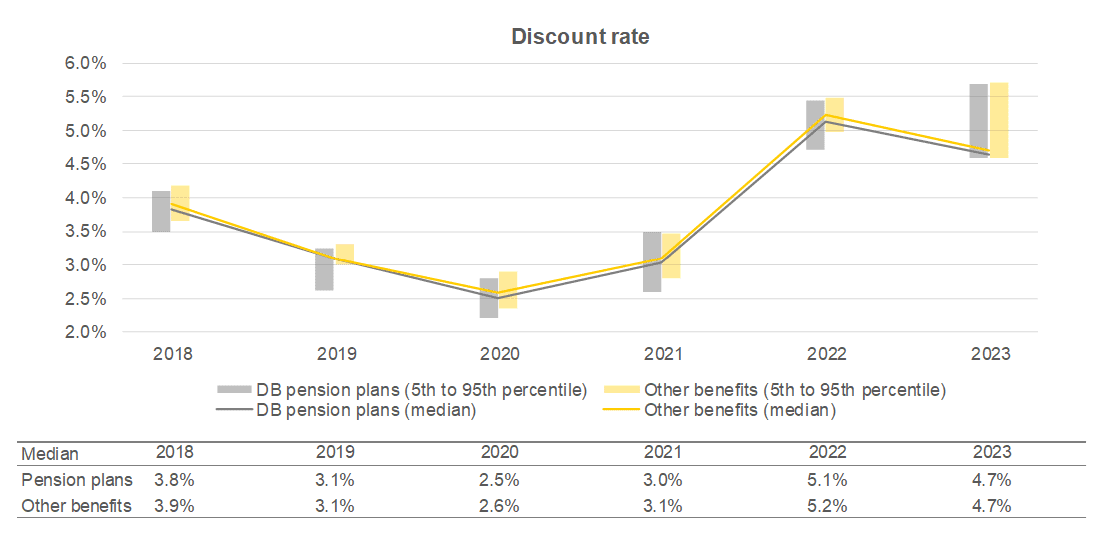
- Following a sharp upward trend since 2021, discount rates dipped slightly by the end of 2023. However, they remain among the highest rates seen over the past few years.
- Discount rates peaked around October 31, 2023, and decreased through December 31, 2023, which explains the larger spread of over 100 basis points seen in the 2023 data points. In fact, most companies who reported higher discount rates during the analyzed period had fiscal years ending around October 31, 2023.
- The closeness of the median and lower percentiles is explained by the fact that the bulk of the analyzed organizations have fiscal years ending December 31, 2023, where we had seen a decrease in discount rates.
Compensation growth rate
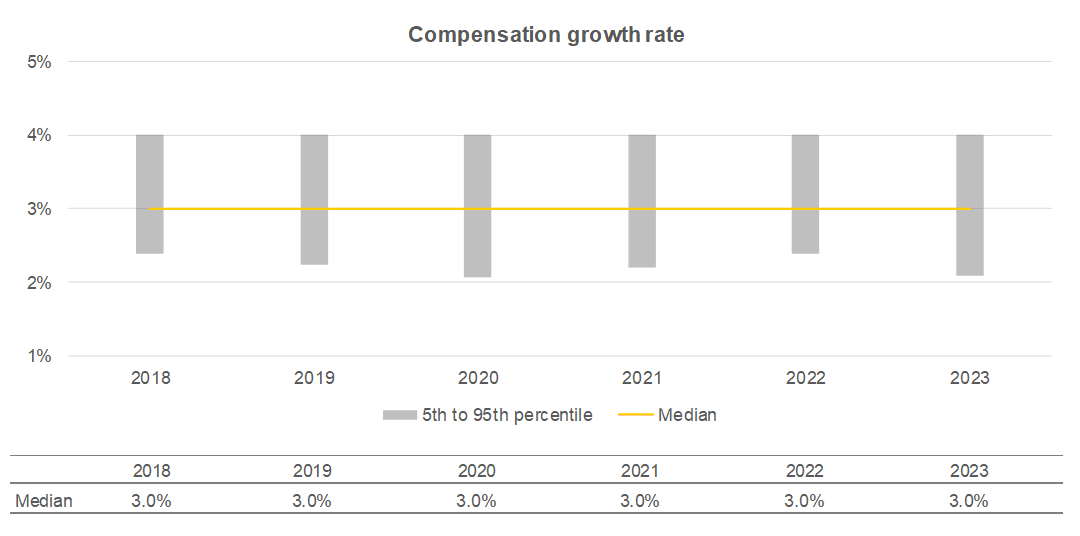
Many of the analyzed organizations sponsor DB pension plans and other benefits with entitlements based on salary at retirement. These organizations must therefore establish an assumption tied to the rate of increase in active members’ compensation.
The following chart illustrates how compensation growth rates have evolved over time:
- Despite the recent period of high inflation, the median of assumptions for the compensation growth rate has remained stable for several years.
Growth rate of medical care costs
The growth rate of medical care costs is a very important assumption for group benefit plans offered to retirees, as it shapes future costs and its growth is higher than overall inflation.
Most organizations use an initial rate that decreases over a specified period into a final rate, to be applied to subsequent years. The initial rate can vary significantly from one organization to another compared to the final rate, which usually varies less.
The following chart illustrates how the initial and final growth rates of medical care costs have evolved over time:
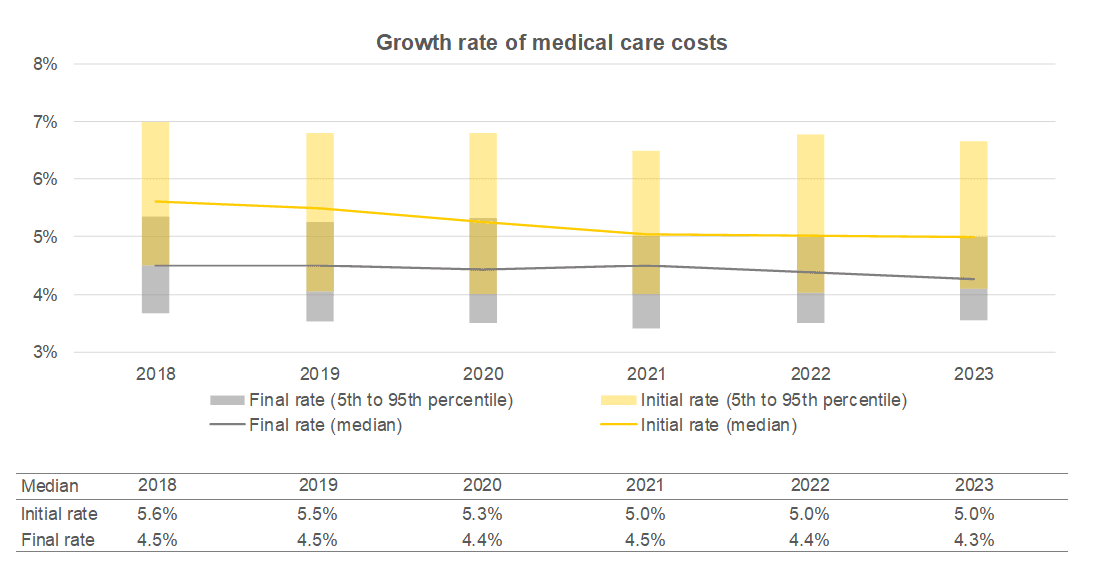
- In recent years, there has been a general downward trend in the growth rates of medical care costs. However, 2023 was the second year in a row in which the median of the initial rate assumption remained unchanged and in which a slight increase in this assumption was even observed in some cases.
- The timeframe to reach the final rate can also vary significantly from one organization to another. About 70% of organizations that offer at least one health care plan to their retirees use decreasing rates, over a period ranging from 10 to 20 years for most organizations
Latest Updates
ACCOUNTING STANDARDS FOR THE PUBLIC SECTOR
At the end of March 2024, the Public Sector Accounting Board (PSAB) reviewed and provided feedback on amendments to the Exposure Draft “Employee Benefits, Proposed Section PS 3251”. The Board concluded that significant changes have been made to the guidance proposed in the Exposure Draft, requiring re-exposure in alignment with PSAB’s standard-setting procedures. Re-exposure documents are expected to be presented for the Board’s approval in June 2024.
The first exposure draft was published in late July 2021, and concerned the proposed Section PS 3251, pertaining mainly to deferral provisions (deferred recognition of actuarial gains and losses) and discount rates. The proposed standard would replace Sections PS 3250, Retirement benefits, and PS 3255, Post-employment benefits, compensated absences and termination benefits. See our August 2021 bulletin for a summary of the key proposed changes.
ACCOUNTING STANDARDS FOR PENSION PLAN FINANCIAL STATEMENTS
The Accounting Standards Board (AcSB) reviewed a proposed exposure draft that would amend Section 4600, “Pension Plans”, to improve the presentation and disclosure requirements related to investments held by pension plans. The proposals would aim at improving fair value disclosures, disclosures on interests in investment vehicles and presentation and disclosure of investment expenses. The AcSB planned to issue its exposure draft before the end of spring 2024.
Our experts assist many clients in preparing their financial statements. We can help ensure that you are in compliance with the accounting standards. Contact us!