See the Latest Updates section for more information on the accounting standards updates since our last bulletin in June 2024.
Many private-sector organizations must include in their financial statements the recognition of their obligations toward defined benefit pension plans (DB pension plans) and other post-employment benefit plans, such as medical care plans offered to retirees (other benefits).
Similarly to last year, Normandin Beaudry’s specialists have analyzed the annual reports of Canadian organizations listed on the S&P/TSX 60 Index (the 60 largest organizations) and on the S&P/TSX Mid Index (mid-cap organizations) for which the fiscal year ended between September 30, 2024, and February 28, 2025.
This analysis included about 65 organizations from the S&P/TSX 60 Index and the S&P/TSX Mid Index that sponsor at least one DB pension plan. Of these organizations:
- more than 80% also disclose information regarding other benefits.
- more than 80% disclose their results in accordance with international accounting standards, while the others disclose them in accordance with U.S. accounting standards.
ANALYSIS OF THE PRIMARY ECONOMIC ASSUMPTIONS USED
The following charts show the key economic assumptions used by the organizations analyzed for their DB pension plans and other benefits. The assumptions are those that were in effect at the end of the fiscal year considered and used to calculate the obligation at the end of the fiscal year.
Each chart shows how the assumptions have evolved over time. Medians are represented by a solid line and shaded floating bars represent the range from the fifth to the ninety-fifth percentile.
It should be noted that certain organizations offer plans in different countries. Some organizations disclose assumptions for plans in Canada separately, whereas others disclose average assumptions for all countries. While this could have an impact on the range of results, the median remains representative of Canadian assumptions.
Discount rate
The discount rate is one of the most important assumptions. Because it is based on market rates, it can vary from month to month. The discount rate can also vary depending on the methodology used to determine the market rate, the plan’s maturity profile and the duration of the benefit offered (for example, a lump sum amount upon retirement or annual payments until age 65 rather than lifetime benefits). The obligation’s sensitivity to the discount rate variation depends on its duration. For example, for the same 0.1% decrease in the discount rate:
- a plan whose obligation has a duration of 10 years will see its obligation increase by approximately 1%
- a plan whose obligation has a duration of 20 years will see its obligation increase by approximately 2%
The following chart illustrates how the discount rates for DB pension plans and other benefits have evolved over time:
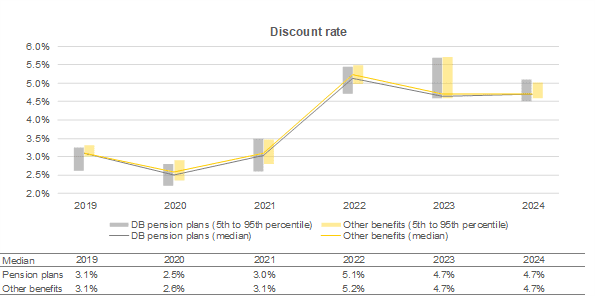
- The median discount rate remained similar at the end of 2024 when compared to the end of 2023. Rates therefore remain fairly high, despite the fact that the Bank of Canada lowered its key interest rate in the second half of 2024.
- The spreads between the discount rates used at the end of 2024 significantly decreased compared to those observed at the end of 2023, aligning more closely with the spreads observed in previous years. Last year, the discount rates peaked around October 31, 2023, and then decreased until December 31, 2023, which explains the large spread of over 100 basis points seen in the 2023 data.
Compensation growth rate
Many of the analyzed organizations sponsor DB pension plans and other benefits with entitlements based on salary at retirement. These organizations must therefore establish an assumption tied to the rate of increase in active members’ compensation.
The following chart illustrates how compensation growth rates have evolved over time:
- The median of assumptions for the compensation growth rate has remained stable for several years, despite certain periods of higher inflation.
Growth rate of medical care costs
The growth rate of medical care costs is a very important assumption for group benefit plans offered to retirees, as it shapes future costs and its growth is higher than overall inflation.
Most organizations use an initial rate that decreases over a specified period into a final rate, to be applied to subsequent years. The initial rate can vary significantly from one organization to another compared to the final rate, which usually varies less.
The following chart illustrates how the initial and final growth rates of medical care costs have evolved over time:

- For several years, we observed a general downward trend in the growth rates of medical care costs. However, the median of the initial growth rate has remained relatively stable since 2021, while the median of the final rate continued to gradually decrease.
- The timeframe to reach the final rate can also vary significantly from one organization to another. About two thirds of organizations offering at least one health care plan to their retirees use decreasing rates, over a period ranging from 10 to 20 years for most organizations.
Latest Updates
ACCOUNTING STANDARDS FOR THE PUBLIC SECTOR
In mid-October 2024, the Public Sector Accounting Board (PSAB) published a re-exposure draft on section PS 3251, the new standard for employee benefits that would apply to Canadian public sector entities and would replace sections PS 3250, Retirement Benefits, and PS 3255, Post-employment Benefits, Compensated Absences and Termination Benefits. In the re-exposure draft, the PSAB proposes to amend certain provisions in response to feedback received in 2021 following the first exposure draft, particularly relating to the discount rate. See our November 2024 bulletin for a summary of the main proposed amendments.
In its 2025-2026 Annual Plan, the PSAB plans to issue Section PS 3251 and continue its research for the next phases of the Employee Benefits project, including those related to risk-sharing plans and other types of non-traditional plans.
ACCOUNTING STANDARDS FOR PENSION PLAN FINANCIAL STATEMENTS
The Accounting Standards Board (AcSB) published an exposure draft that would amend Section 4600, Pension Plans, to improve the presentation and disclosure requirements related to investments held by pension plans. The proposals would aim at improving fair value disclosures, disclosures on interests in investment vehicles and presentation and disclosure of investment expenses. The comment period ended in October 2024, and the AcSB plans to publish the final text of the amendments in the second quarter of 2025. The AcSB has indicated that these amendments will apply to fiscal years beginning on or after January 1, 2027, and that early application will be permitted.
Our experts assist many clients in preparing their financial statements. We can help ensure that you are in compliance with the accounting standards. Contact us!