
The journey of a skillful employee TM
An inspiring journey for employees can be created by adopting a total rewards approach that offers both equitable compensation and the opportunity to achieve career aspirations. When creating such a journey, salary progression and career should be aligned with the employee’s development of competencies. Equipping managers with the tools to develop talent based on that conviction gives skillful employees a springboard and has a positive impact on attracting and retaining talent.
Now more than ever, organizations are operating in a changing world. Employers must put employee interests front and centre to ensure their well-being at work. To attract, engage and retain talent, it is important to offer a stimulating employee experience that helps employees find meaning at work through rewarding career paths.
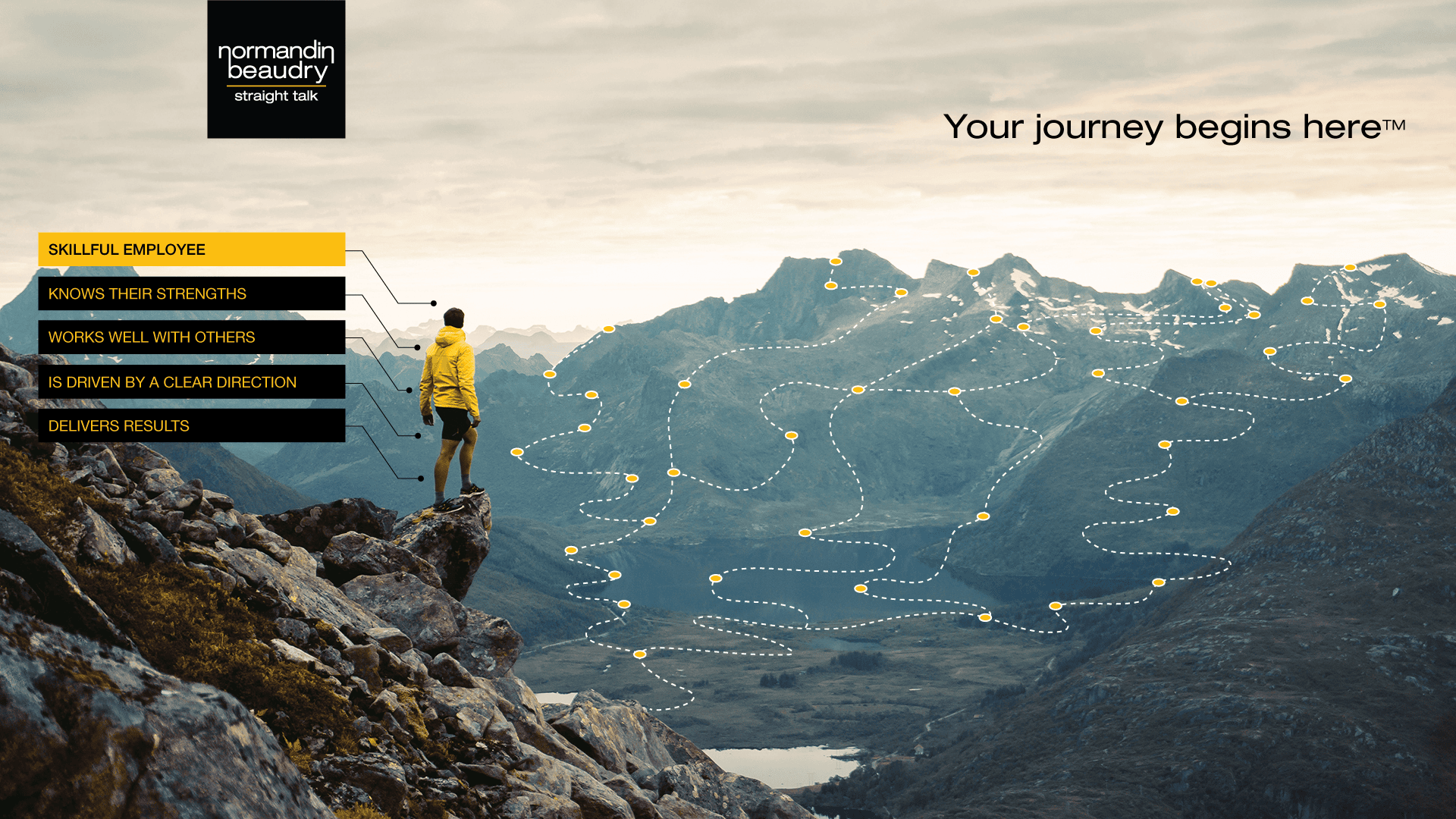
The journey of a skillful employeeTM concept illustrated by Normandin Beaudry
The journey of a skillful employeeTM concept is an excellent lever for developing competencies, which then play a key role in helping employees successfully navigate their career paths. By having a clear picture of the various career options available, skillful employees can choose the path that aligns with their ambitions and pace, as well as the personal peak they want to reach. Skillful employees know their strengths, work well with others, are driven by a clear direction and deliver results, enabling them to achieve their professional aspirations.
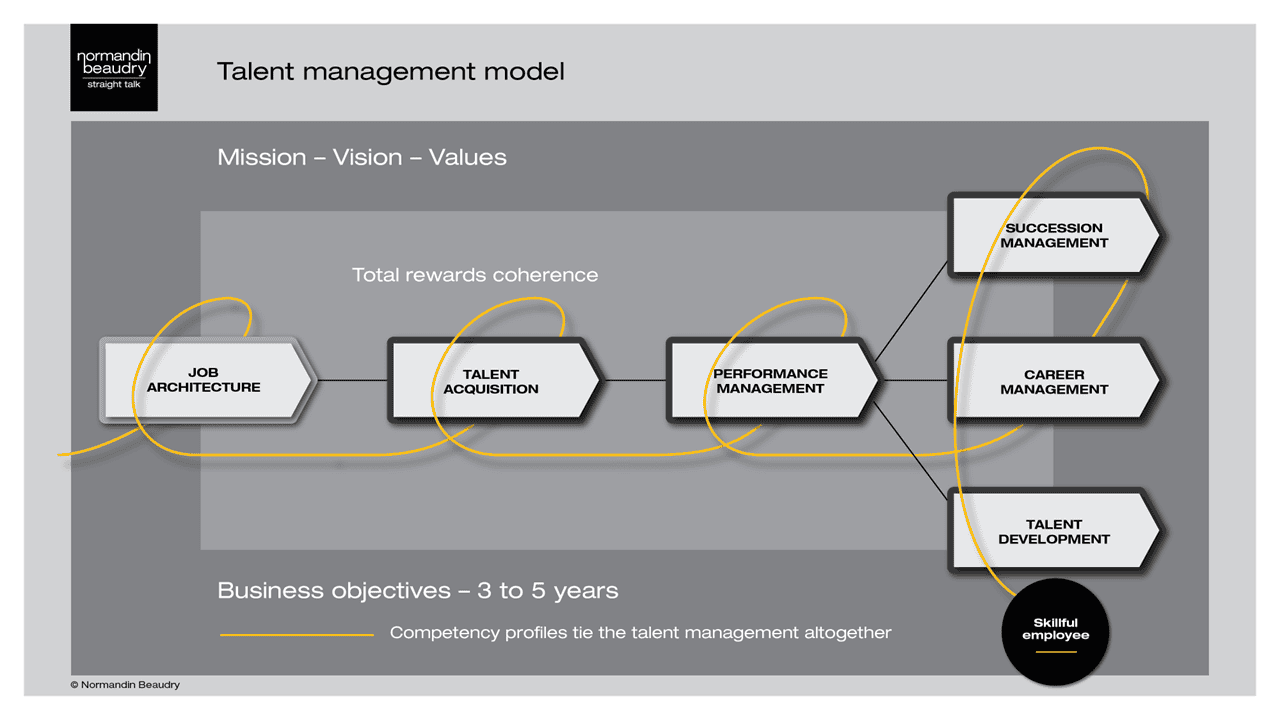
Normandin Beaudry’s talent management model
Inspiring career paths can be created by developing a job architecture that classifies and maps available jobs within the organization, clarifies potential paths and offers adequate compensation to ensure internal equity.
Once properly developed and communicated, this structure dictates recruitment needs and the organization’s capacity to attract skillful employees—also known as staffing.
When the right people are in the right jobs, they want to generate performance. That’s where performance management comes into play by supporting skillful employees in their desire to perform and go above and beyond.
Taking the time to learn about employees’ performance and how they are growing and developing makes it possible to plan for the next generation, manage careers within the organization and enable employee growth through competency development.
To bring out the best in skillful employees and help them have a meaningful experience, it is crucial to create balanced competency profiles. While creating these profiles, it is strongly recommended to align them with the organizational strategy, while analyzing context and business needs, and drawing on the criteria of a high-performing organization, meaning one that:
- is client-centric;
- creates lasting value;
- has a vibrant culture;
- aims for operational excellence; and
- implements well-thought-out strategies.
Using a competency framework makes it possible to build balanced behavioural competency profiles that outline the precise expectations associated with each career path in a more objective way. Skillful employees then have a clearer idea of where to direct their efforts in order to keep growing and moving forward.
Once the competency profiles are created, the synergies between the various talent management programs make perfect sense.
For example, in the performance management process, the overall performance rating generally reflects the employee’s achievement of annual objectives, proficiency in competencies and conduct in their work. The rating also has an impact on the employee’s salary progression within their pay scale. If the annual meeting between the employee and manager focuses only on the overall performance rating, the conversation is short and fruitless.
However, if the manager has additional tools to help the employee visualize possible career paths and the competencies needed to advance and develop professionally, then they are supporting the employee in their career path by showing them the rewarding journey they can embark on! The relationship between the employee and organization turns into a genuine partnership. Trust takes root and begins to flourish. Consequently, compensation rewards progression, not necessarily a promotion.
In conclusion, the concept of the skillful employee applies to all types of organizations, regardless of size. It helps the employer attract and retain talent with the promise of an inspiring professional journey and equitable compensation. It gives the employee a clear picture of the career paths available so they can grow and develop based on their strengths and professional aspirations.
By knowing the architecture of available jobs in the organization and the competencies they need to develop to reach their personal peak, skillful employees can easily find where THEY fit into the organization.
This article was written by:
Geneviève Cloutier, CHRP
Partner, Compensation and Performance
Normandin Beaudry
Mélanie Trudelle, CHRP
Principal, Compensation
Normandin Beaudry