The race for productivity is inherent to the modern organization, which must be agile, competitive and on top of technological advances. Despite this well-known fact, only 41% of employees feel they are performing optimally: that is putting their best foot forward and maintaining their effort in the long term1.
With increasing focus being placed on striking a balance between performance and health, how can we encourage full contribution without leading to stress and disengagement?
Normandin Beaudry’s organizational development specialists believe that talent management should consist in leveraging the natural preferences of each individual to drive them to achieve their personal best and sustain that performance over time. This approach of amplifying performance allows everyone to unlock their full potential and contribute optimally.
Solution
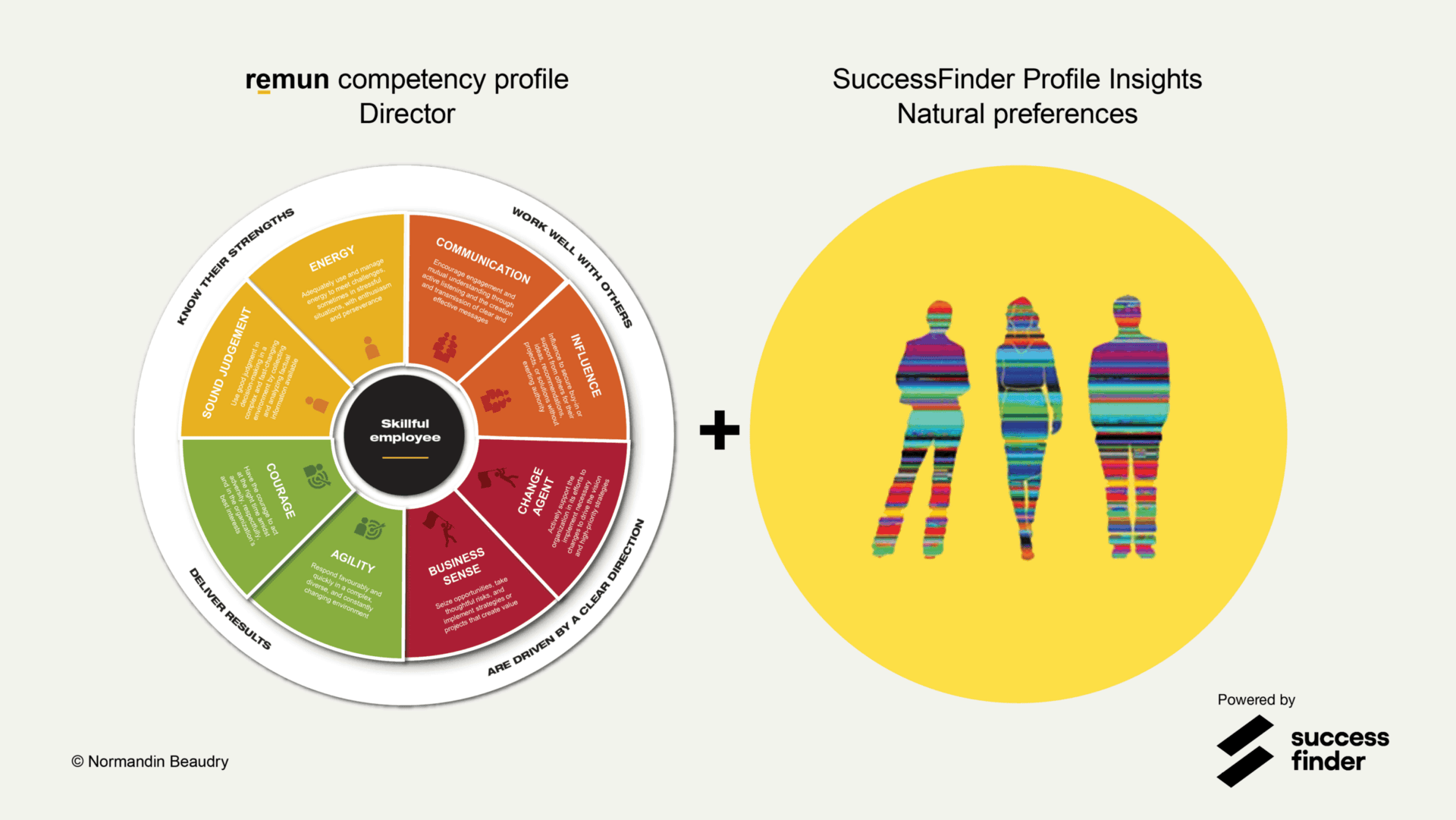
Two management inputs are needed in strengths-based management:
- An up-to-date competency profile aligned with the organization’s mission, vision and values
- SuccessFinder Profile Insights2 (SFPI) that identify an individual’s natural preferences
Managers are accustomed to communicating management expectations. However, the energy scorecard below takes natural preferences into account to organize work and explore development opportunities in a bold and energizing way. That’s what makes this combination of data relevant to strengths-based management, which leverages the competencies identified by Normandin Beaudry and the natural preferences defined by SuccessFinder.
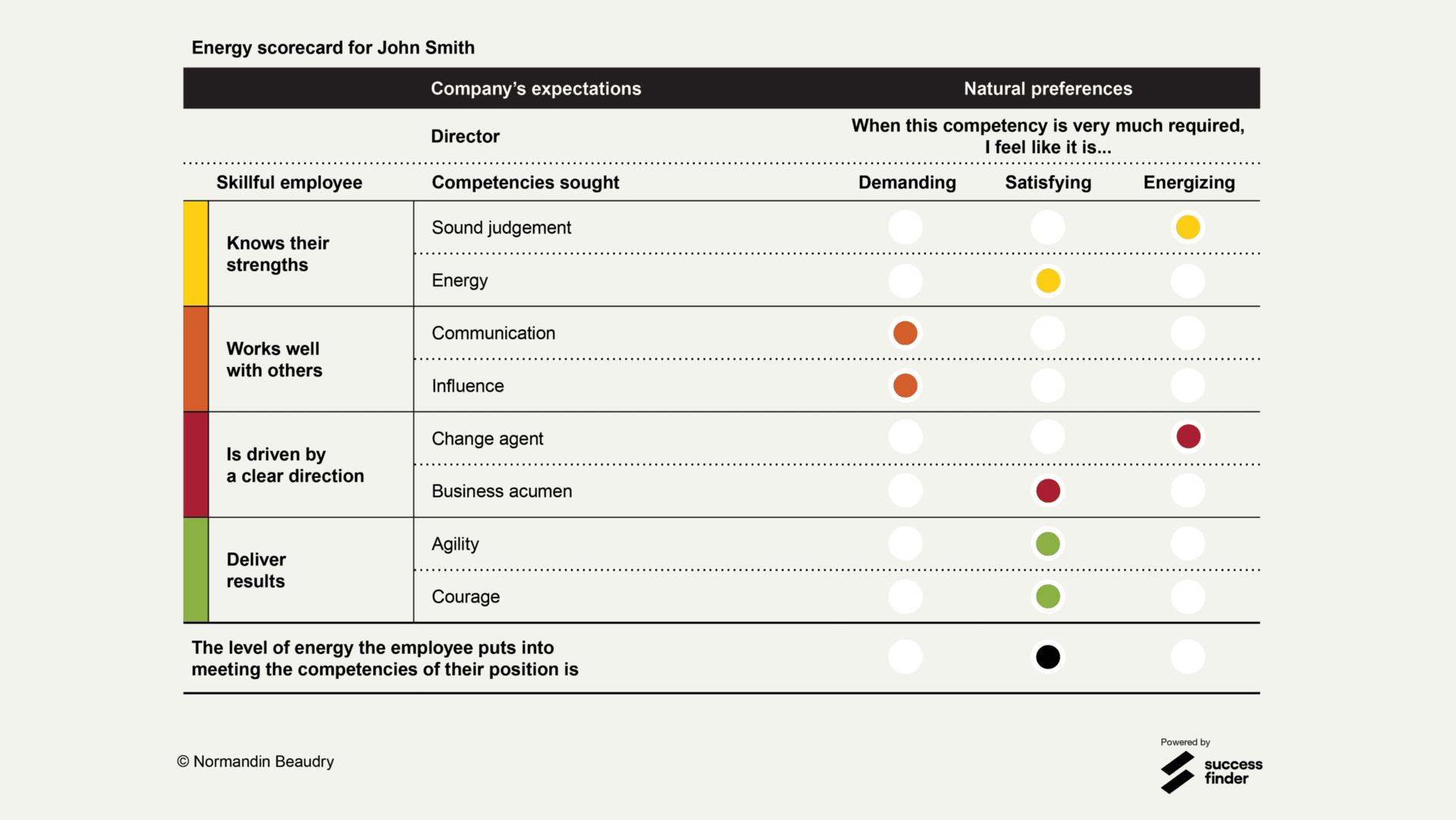
Let’s explore the energy scorecard using the example of John Smith, who holds an executive position.
On the left are the organization’s expectations, broken down into eight behavioural competencies.
On the right is the energy output when a competency is used extensively: does it feel demanding, satisfying or energizing?
Results can be interpreted as follows:
- The more John is exposed to complex situations and has the leeway to make decisions, the more motivated and energized he will be (energizing competencies: sound judgement, change agent).
- To preserve his energy, it would be best for him to be around people who are able to manage stakeholders and foster engagement (demanding competencies: communication, influence).
The unique value of our solution
The aim of amplified performance is to support a sustainable level of contribution over time, which involves:
- Managers who are comfortable engaging in impactful managerial conversations about work organization and development, and
- Individuals who know their potential for excellence and leverage it every day.
To achieve it, the energy scorecard is the starting point for exploring how a person can give it their all while taking into account management expectations and natural preferences.
Here are three examples of conversations facilitated by the energy scorecard:
1. Clarify expectations
An ideal time to use the energy scorecard is when clarifying expectations. The competency profile is the key to communicating expectations. Competencies identify the behaviours required to meet performance expectations, bringing clarity and consistency. The more a manager is able to connect this information to team priorities, the greater their impact will be.
When expectations are clearly set out and understood, individuals have the foundations to feel autonomous and competent. On the other hand, ambiguous expectations can generate unnecessary stress for employees and lead to two possible scenarios:
- Avoiding risks and limiting their contributions.
- Putting in far too much effort for what is expected.
Communicating expectations prevents everything from being left to interpretation.
2. Move from expectations to agreement
Once expectations are clearly understood, it’s important to consider the impact of each competency on energy and make the choice to engage in strengths-based management. Starting with the competencies that are required most and least often in daily work, and their impact on energy levels, adds depth to managerial conversations.
Moving beyond expectations, managers can open the discussion by considering the person in relation to the position they occupy. Another point to consider is that job crafting is on the rise in this VUCA (volatile, uncertain, complex, ambiguous) environment. Standard job descriptions are making way for detailed roles, responsibilities and specific expectations that change yearly. Job crafting must be based on clarity about the expected competencies and natural preferences of each person .
This lays the groundwork for a promising conversation on how a person can influence the expression of their leadership within the framework of the Journey of a skillful employeeTM!
Moving from expectations to agreement means being flexible in crafting jobs to ensure that a person can be at their best 80% of the time. This arrangement reduces the risk of burnout and reinforces full contribution in a sustainable way . It also means agreeing on the minimum effort required and organizing the work according to team members’ complementary strengths.
3. Adapt and grow in a bold and energizing way
A resilient organization is one whose people are willing to step out of their comfort zone and continuously adapt. The more someone is in the zone that energizes them, the more courage they have to explore, despite any discomfort.
Every day, a person has the choice to learn, integrate and become a more versatile version of themselves. Normandin Beaudry’s energy scorecard helps set highly personalized development objectives that consider the level of proficiency in a competency and its impact on energy.
Our experience with clients is clear: when objectives are tailored to individuals and support is provided, development takes place through action. Placing value on natural preferences in managerial conversations motivates individuals to seek out opportunities to challenge themselves, receive support, learn, and redefine themselves within an ever-changing work environment. This mindset is what builds a true culture of learning and performance.
A solution to boost productivity
Providing guidance while recognizing that individuals are on their own journey fosters lasting engagement. A lack of opportunities and challenges leading to growth and progression is the leading cause of departures in Canadian organizations5.
Refocusing managerial practices on strengths-based management accelerates acceptance of change and boosts execution speed, which are vital to the productivity of Canadian organizations.
This article was written by
Nadia Boucher, M.Sc., CHRP, PCC, SuccessFinder Expert Level certified
Principal, Performance
Nadia is an impactful business partner and large-scale project manager who has assisted several client groups with leadership development and organizational transformation projects over the past 15 years.
She has worked for a major financial institution and in the video game industry.
Nadia has a master’s degree in HR management, Professional Certified Coach and SuccessFinder Expert Certification. At Normandin Beaudry, she is actively involved in both talent management and the dynamics of high-performance teams.
Geneviève Cloutier, M.Sc., CHRP Fellow
Compensation and Performance Partner
Geneviève has 25 of experience in compensation and performance: first with an international consulting firm, where she worked with many clients in Canada and the United States, and since 2006 with Normandin Beaudry. Under her leadership, the Compensation practice became the largest in Quebec and Canada and began leveraging robust tools such as remun. More recently, Geneviève has been devoting her energy to developing the Performance practice in order to offer our clients specialized services focused on the employee experience, talent management and organizational efficiency.
After nearly 10 years on Normandin Beaudry’s Executive Committee, Geneviève is now the chairwoman of the firm’s Board of Directors. She is frequently asked to share her ideas at public forums. Her expertise and commitment to the profession earned her the Incountournable des ressources humaines award from Premières en Affaires magazine in 2014, and the Prix Engagement in 2020, a distinction awarded by the Ordre des CRHA. She has also received the Fellow distinction.
- Three Cues to Unlock Employees’ Optimal Performance, A CHRO guide to signaling path, pace and progress, https://www.gartner.com/en/human-resources/trends/three-cues-to-unlock-employees-optimal-performance, Gartner, 2023.
- SuccessFinder Profile Insights (SFPI) provide a comprehensive overview of employees’ natural preferences and behavioural traits, to help organizations support their workforce at every stage of development.
- Crafting for autonomy, competence, and relatedness: A self-determination theory model of need crafting at work (Anja H. Olafsen, Baptiste P. C. Marescaux, Miika Kujanpää) Applied Psychology, August 2024
- Crafting for autonomy, competence, and relatedness: A self-determination theory model of need crafting at work (Anja H. Olafsen, Baptiste P. C. Marescaux, Miika Kujanpää) Applied Psychology, August 2024
- remun survey (2024–2025), Talent and Culture, Normandin Beaudry