This summer, more than 800 organizations across Canada participated in the 16th edition of Normandin Beaudry’s Salary Increase Survey. The detailed analysis prepared by our compensation specialists offers a comprehensive perspective on emerging market trends and provides organizations with valuable information to support their compensation planning.
For additional information, refer to our interactive tool.
Highlights
As Canada has entered a technical recession following two consecutive quarters of economic contraction, strategic planning relevant to salary increases is essential in retaining talent and maintaining workforce strength.
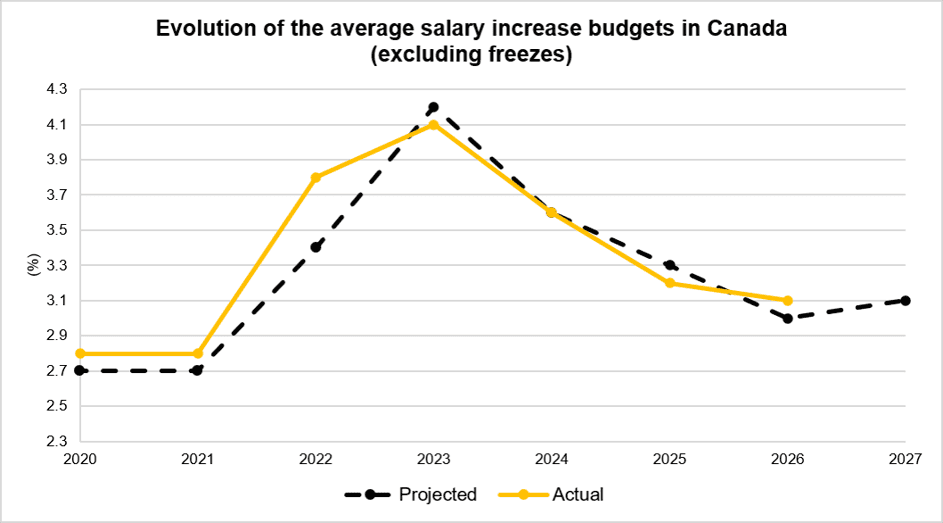
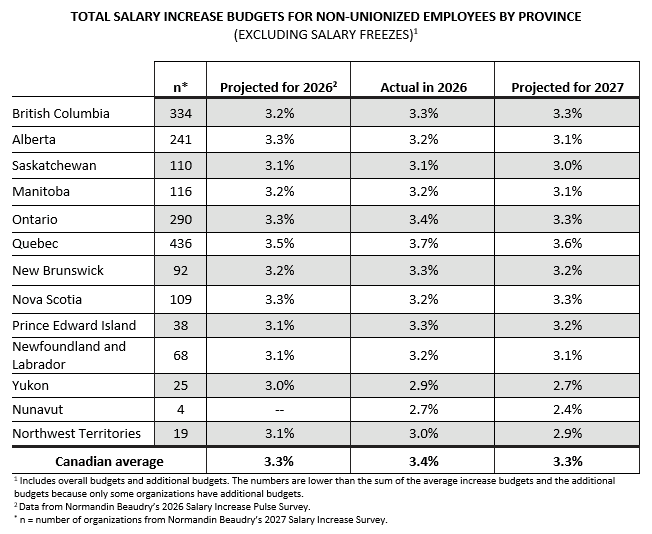
In 2027, organizations are anticipating holding their salary increase budgets steady to previous years with an average projected increase of 3.1%, excluding salary freezes, aligned with the 3.1% granted in 2026.
Only 1.7% of respondents reported freezing salaries in 2026, lightly below the initial forecast of 2.3% published in September 2025. The 2027 survey shows 3.6% of respondents projecting salary freezes for 2027.
With results on par with responses from last year, and few organizations freezing salaries, employers are exhibiting caution when preparing for the upcoming year. Retention and market competitiveness remains an important factor despite the economic uncertainty.
Projections by ownership structure
2027 salary increase budget projections show minimal differentiation across ownership structures:
- Privately held (not listed on the stock market): 3.2%
- Not-for-profit: 3.0%
- Publicly traded: 3.1%
- Government/Crown corporation: 2.9%
Industry sectors reporting high increases
Organizations in the construction of buildings sector reported the highest granted salary increase budget in 2026 at 3.6%, with the following sectors also reporting higher than average increases this past year:
- Professional, scientific and technological services: 3.5%
- Telecommunications, data processing, data warehousing and related services: 3.5%
- Finance and insurance: 3.4%
- Real estate, rental and leasing: 3.4%
Projected 2027 salary increase budgets indicate that the telecommunications, data processing, data warehousing and related services sector as well as the finance and insurance sector will continue to maintain higher salary increase budgets with a 3.4% increase.
Historical salary increase budgets
Salary increase budgets – Results
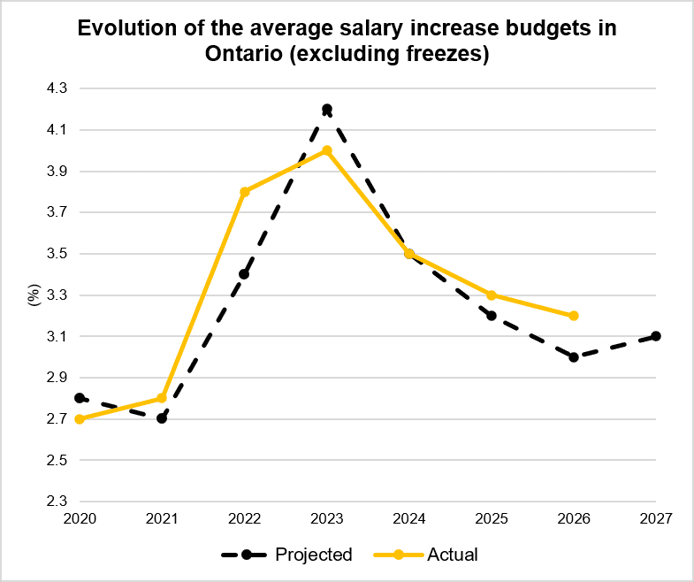
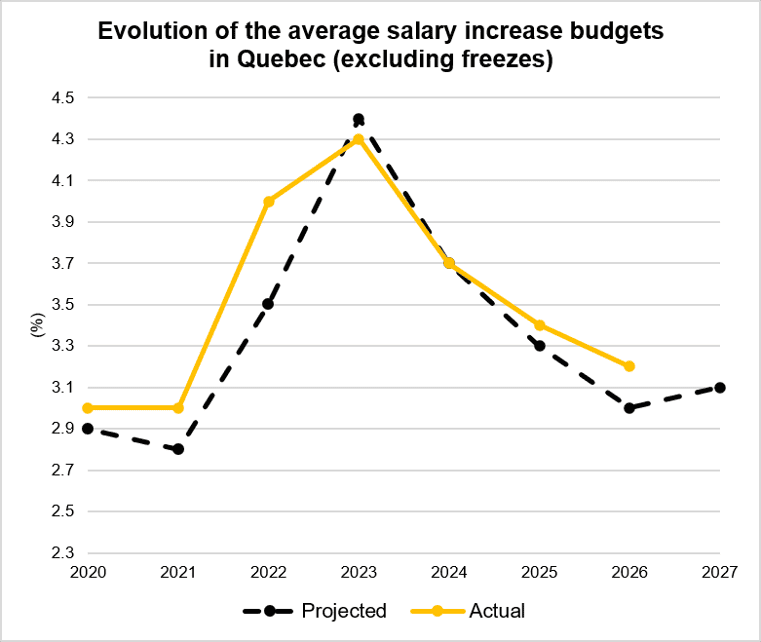
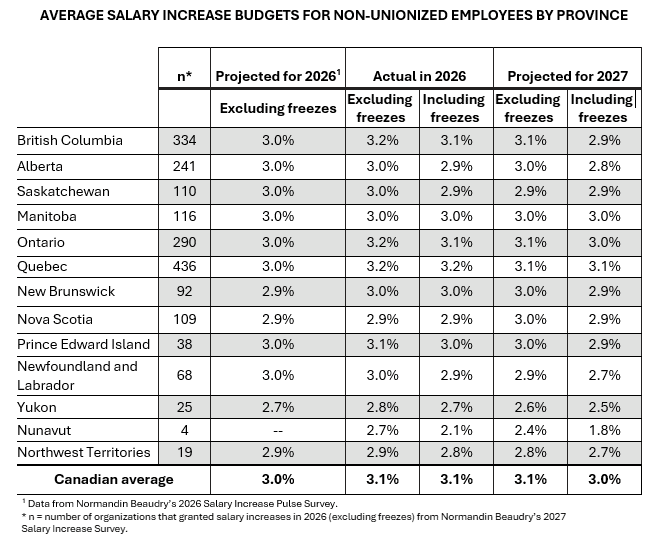
Actual increases in 2026 (excluding salary freezes) were slightly above the most recent projection of 3.0% published in January 2026, with average increases trending to 3.1%. These figures indicate that organizations remain cautious when determining their compensation strategies.
Most provincial projections report that 2027 increases will be aligned with or lower than the national average of 3.1%.
Additional ad hoc budgets
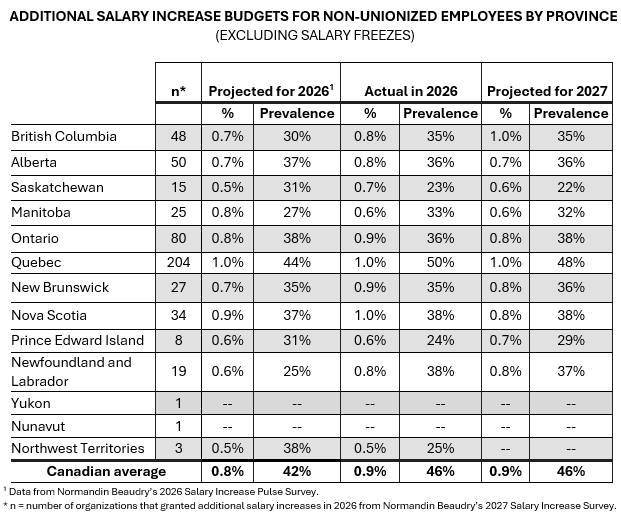
In 2026, 46% of responding organizations allocated an average additional budget of 0.9%, slightly higher than the initial January 2026 projection. For 2027, projections show that the same percentage of organizations (46%) are planning to secure additional budgets, maintaining an average of 0.9%.
These organizations are planning to allocate them for the following purposes:
- Support market adjustments to salaries (67%)
- Differentiate compensation for high performers (55%)
- Retain employees in strategic/critical roles (50%)
- Accelerate progression for employees lower in their pay range (40%)
- Address compression and internal equity challenges (34%)
- Retain employees with a perceived retention risk (32%)
- Provide for off-cycle salary increases (24%)
Total salary increase budgets (including additional budgets)
When accounting for reported additional budgets planned for 2027, average total salary increases expect to reach 3.3%.
Salary structure increases for non-unionized employees
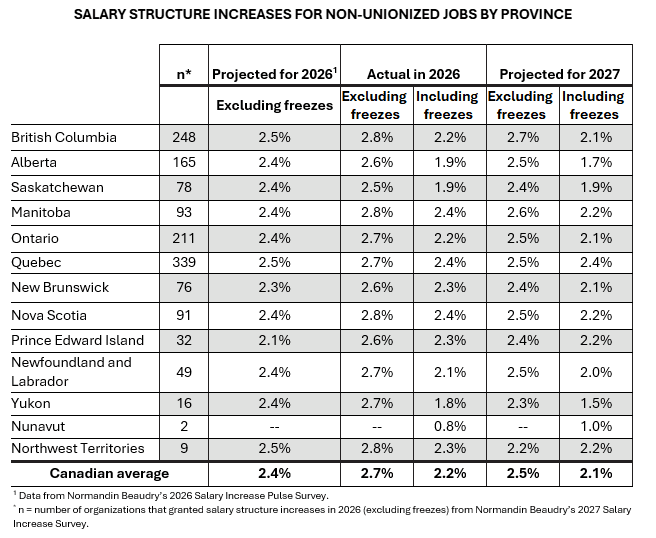
The average salary structure increase in 2026 was 2.7%, excluding organizations reporting a structure freeze, and 2.2% when including those organizations. Although initial 2026 projections suggested an intention towards moderate salary structure increases, actual results show that organizations ultimately maintained increases at the prior-year level. This gap between projected and actual adjustments suggests that continued market pressures and competitiveness limited their ability to reduce salary structure movement as initially intended.
Actual 2026 salary structure increases (excluding freezes) continue to remain consistent with that of the previous compensation cycles:
- 2024: 2.6%
- 2025: 2.7%
- 2026: 2.7%
Projections for 2027 signal more prudent salary structure increases, with an average of 2.5% (excluding freezes). These increases provide anecdotal evidence that organizations are continuing to approach salary structures with a focus on affordability so as to preserve cost structures when managing annual increases.
Conclusion
Given ongoing economic uncertainty, the results indicate that organizations are taking a cautious but steady approach to their salary increase planning for 2027. While projections suggest a slight moderation in budgets, actual 2026 increases came in above initial projections and salary freezes remained limited. This suggests that organizations continue to balance affordability with the need to remain competitive, retain talent and sustain workforce strength.
Organizations looking to set themselves apart may benefit from innovative approaches that balance monetary and non-monetary elements within their total rewards strategy. Normandin Beaudry’s experts believe that striking the right balance can help organizations stand out from the competition.
Work is changing. Where do you fit in?
Look out for our In the spotlight summary, a snapshot of the results gathered from participating organizations, offering valuable insights into how they are positioning themselves in a rapidly evolving work environment.
See what organizations had to say about these topics:
• The adoption and concrete integration of AI in organizations
• Tomorrow’s key competencies and organizational capabilities
• The evolution of compensation practices.
• The role and strategic positioning of HR in the AI transformation
• Levers for the adoption and ownership of AI by organizations
Interested in receiving a copy of the results? Contact us to request access.
Contact our total rewards specialists to learn more about the results of this survey.
Not on our mailing list? Subscribe now.