Economic uncertainty, workforce pressures and rapid technological change continue to reshape how organizations approach employee benefits. Canadian employers are increasingly being asked to do more with less: manage rising benefits costs, operate with limited internal resources and meet growing employee expectations around health, well-being and workplace support.
Simultaneously, benefits remain a critical component of the employee value proposition. In a competitive labour market, organizations cannot afford to view benefits solely as a cost centre. Instead, they must balance financial sustainability with the need to attract, retain and support their workforce.
Insights from Canadian organizations participating in the MBWL International 2026 Global Benefits Forecast Survey reveal how employers are responding to these challenges and where benefits strategies are headed in the year ahead.
Navigating uncertainty: benefits priorities are shifting
External pressures continue to influence benefits decision-making. Economic uncertainty, geopolitical instability, workforce challenges and accelerating technological change are creating a more complex environment for employers to navigate.
As a result, organizations are becoming increasingly strategic in how they manage their benefits programs. Rather than focusing on isolated initiatives, many are adopting a more integrated approach that balances financial stewardship, employee needs and long-term sustainability.
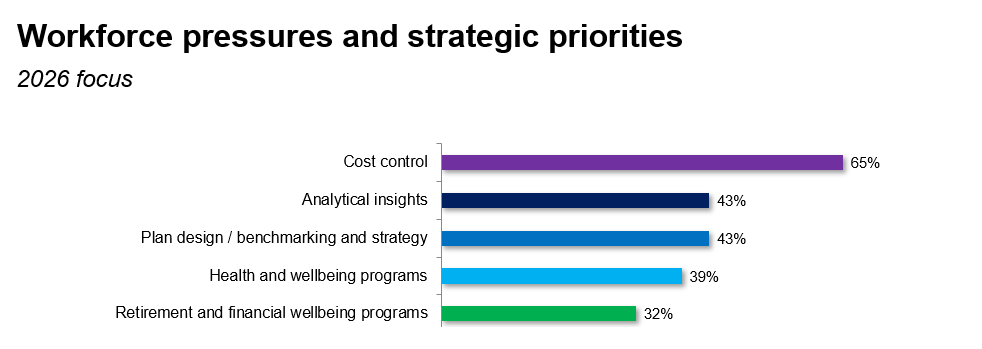
According to the Canadian findings from the MBWL International 2026 Global Benefits Forecast Survey, cost control remains the top priority for employers, cited by 65% of organizations. At the same time, organizations are placing growing emphasis on analytics, benchmarking, strategic planning and employee well-being. These priorities reflect a broader shift toward data-driven decision-making and proactive benefits governance.
The cost equation: managing spend without eroding value
Controlling benefits costs remains the most significant challenge facing Canadian employers, which reflects the ongoing pressure from healthcare inflation, demographic shifts and evolving workforce needs.
Healthcare costs continue to rise, while specialty medications account for an increasingly larger share of overall drug spending. Mental health concerns and disability-related absences also continue to place pressure on employer-sponsored plans. At the same time, aging workforces are contributing to higher utilization of healthcare services and benefits.
Normandin Beaudry’s proprietary data illustrates the magnitude of these pressures. Specialty drugs now account for approximately 45% of prescription drug costs, up significantly from 35% in 2021, and continue to experience staggering cost growth.
Despite these challenges, Canadian employers are largely resisting the pressure to reduce benefits or transfer costs directly to employees. Survey results indicate that only a small minority of organizations are considering this kind of action. Instead, employers are focusing on more sustainable approaches to cost management, including:
- strengthening governance practices,
- improving visibility into plan costs,
- automating administrative processes,
- enhancing employee communications, and
- investing in preventive health and well-being initiatives.
This shift reflects an important evolution in benefits strategy: cost management is no longer viewed simply as a matter of reducing expenses. Instead, it’s increasingly about maximizing value and ensuring that benefits investments deliver meaningful outcomes for both employees and employers.
Employee experience is becoming a competitive advantage
While managing costs remains essential, organizations also recognize that benefits programs must be understood and valued by employees to achieve their intended impact.
Many employers continue to struggle with employee awareness and appreciation of available benefits. In fact, employee understanding of benefits was identified as one of the most significant challenges facing organizations today. As a result, employers are increasingly focused on helping employees better understand the full value of their total rewards package, including benefits, wellness programs, savings and retirement offerings, and other forms of support.
Clear, structured and impactful communication can influence employee perceptions, improve engagement and reinforce the value of an organization’s benefits offering. It can also help employees make better use of available resources and support services, improving both employee well-being and an organization’s return on investment.
Well-being also continues to play a central role in benefits planning. Organizations are investing in programs that support physical, mental and financial health while responding to evolving workforce expectations. These investments are increasingly viewed as important levers for attraction, retention and employee engagement.
The future of benefits: technology and AI reach a turning point
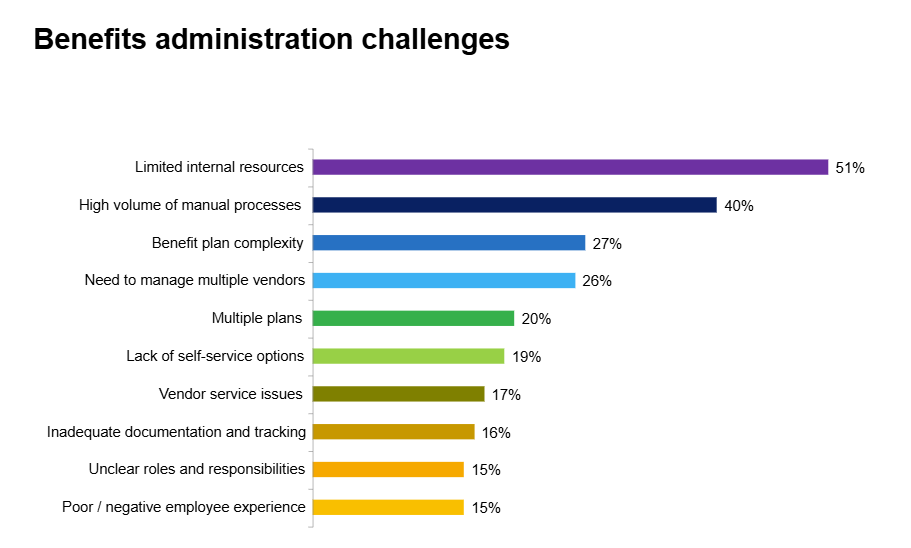
Benefits administration teams are operating in an increasingly complex environment. Many organizations report challenges related to limited internal resources, manual processes and growing administrative demands.
In response, employers are turning to technology to improve both the employee experience and operational efficiency. Technology-driven projects are increasingly focused on making benefits easier to navigate, providing more personalized communications and delivering faster support to employees when questions arise.
These investments reflect changing employee expectations; employees increasingly expect benefits experiences that mirror the ease and personalization they encounter in other aspects of their daily lives. Organizations are therefore looking for ways to simplify interactions, improve accessibility and deliver more relevant information at the right time.
Artificial intelligence is also beginning to influence benefits management. While early adoption remains relatively low, experimentation is accelerating across several areas, particularly employee communications, data analysis and decision support.
For many organizations, the immediate opportunity lies not in replacing human decision-making but in enhancing it. AI can help streamline administrative processes, generate insights from complex data and support more personalized employee experiences. As these capabilities continue to evolve, organizations will have new opportunities to improve efficiency while strengthening the value they deliver to employees.
Sustainable benefits management requires balance
Canadian employers are navigating a challenging environment characterized by rising costs, increasing complexity and evolving employee expectations. As a result, they’re pursuing more balanced and sustainable benefits management strategies.
Success will be closely tied to an organization’s ability to exercise financial discipline while providing a strong employee experience. Effective governance, data-driven decision-making, thoughtful communication and strategic technology investments will all play an important role in achieving this balance.
Our webinars provide valuable insights into the latest developments and emerging trends across Canada.
Didn’t have a chance to attend our June session on Canadian benefits trends? Good news! New webinars are coming this fall. Sign up to stay informed and be among the first to register.
This article was written by:
Sophie Limoges, Principal, Health and Benefits
Dianne Gavieres, Principal, Communication
Francis Lemaire, Consultant, Health and Benefits
Alexandre Bernard, Partner, Investment Consulting