
Normandin Beaudry Pension Plan Financial Position Index, June 30, 2026
Normandin Beaudry has updated its pension plan financial position index as at June 30, 2026, tracking defined benefit pension plans in Canada.

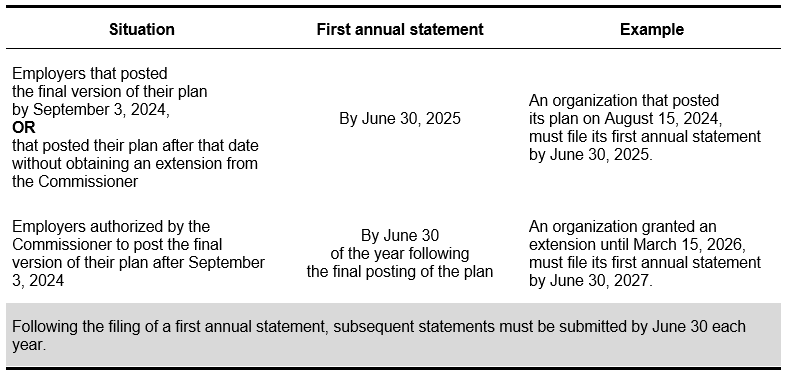
The deadline to file annual statements is fast approaching for federally regulated organizations! Annual statements must be submitted by June 30th each year through the official Pay Equity Annual Statement Portal.
In addition to the annual statement obligation, the Pay Equity Act (the Act) includes a maintenance obligation requiring the plan to be updated every five years, based on its initial posting date. For organizations subject to the Act as of August 31, 2021, and required to post their pay equity plan by September 3, 2024, the plan update is due by September 4, 2029.
Annual statement obligations vary according to the pay equity plan posting date and whether an extension was granted. The table below indicates the main deadlines applicable to each situation.
The information to be provided generally remains the same from one year to the next, unless the pay equity plan is updated (see next section) before the five-year maximum.
Employers with more than one pay equity plan must include information about each separate plan in a single annual statement.
Refer to our checklist before completing your annual statement.
Changes may occur between the time an organization posts its final plan and when a plan update is required. Normandin Beaudry’s proposed governance approach helps identify changes to monitor in total rewards programs and policies, and in organizational design, to mitigate the risk of non compliance with pay equity legislation. This approach takes into account the various groups involved and the collaborative strategies to be considered during this maintenance period. In short, it ensures organizations are prepared to update their plan within the required deadlines.
The update is intended to correct any differences in compensation (pay gaps) resulting from changes likely to have had an impact on pay equity since the most recent posting of the pay equity plan. In order to maintain pay equity, analyses will continue to be needed over the long term and updates must be carried out with a committee if your organization has:
An update is required every five years but can be done more frequently (e.g. every year) in order to:
It is therefore advisable to take a proactive approach to maintaining pay equity. Depending on the organization’s existing culture and collaboration methods, committee meetings may be held more regularly to conduct targeted analyses in the event of major changes, such as:
Regardless of whether they are documented in an official update to the pay equity plan, these actions help foster equitable compensation and compliance with the legislative framework.
Ensuring pay equity can be a springboard for establishing an internal equity process within an organization. Setting up mechanisms to regularly review and monitor compensation practices among different job groups makes it possible to pursue long-term internal equity, which fosters an inclusive organizational culture for all job classes, including gender-neutral and predominantly male jobs.
Analyzing pay equity can also reveal broader issues. As the process does not take gender-neutral job classes into account, compensation for these classes may not be aligned with internal equity principles. Some predominantly male job classes may also be undervalued in relation to other comparable jobs. To summarize, even if there are no official differences in compensation under the Act, it is important to identify and correct any internal imbalances to ensure that compensation is equitable.
Drawing on our expertise in Canadian pay equity legislation, we encourage a proactive governance approach to ensure you are prepared for your next plan update. To discuss the best strategy for your organization’s reality, contact our specialists or write to us.